


Research Article
Head in the (Oil) Sand? Climate Change Scepticism in Canada
Gary J. Pickering*
Department of Biological Sciences and Psychology, and Environmental Sustainability Research Centre, Brock University, 500
Glenridge Ave, St. Catharines, ON L2S 3A1, Canada
*Corresponding author: Gary J. Pickering, Professor, Biological Sciences and Psychology, Brock University, 500 Glenridge Ave, St. Catharines, ON L2S 3A1, Canada, Tel: +1 905 688 5550, Fax: 1 905 688 3104; E-mail: gpickering@brocku.ca
Article Information: Submission: 15/08/2015; Accepted: 26/08/2015; Published: 01/09/2015
Copyright: © 2015 Pickering GJ. This is an open access article distributed under the Creative Commons Attribution License, which permits unrestricted use, distribution, and reproduction in any medium, provided the original work is properly cited.
Abstract
Determining the extent to which specific psychological barriers limit climate change mitigation behaviour, particularly in individuals from industrialised
nations with poor mitigation performance, is a global concern. This pilot study sought to establish for the first time the extent of climate change scepticism
in a representative sample of Anglophone Canadians and determine how it may vary with knowledge, values and socio-demographic factors. Participants
(n=229) responded to a mail invitation to take part in the online survey. Scepticism and uncertainty toward climate change were assessed using a validated
12-item attitude index that yielded a composite scepticism score. Environmental values were assessed using a modified version of the New Environmental
Paradigm scale (NEP), while political association, education attainment, climate change knowledge, and several demographic variables were determined
using established measures. A full factor multiple regression analysis showed region, NEP score and Conservative Party of Canada association as the
significant predictors of scepticism. When independent factor groupings were modelled separately, values and politics explained 31% of the variation in
scepticism scores, socio-demographic variables 6%, and education and knowledge 3%, highlighting the dominant role of environmental values and political
orientation. These results are discussed in the context of the theory of socially-organised denial of climate change and the information-deficit model of climate
inaction. The findings provide baseline data that will allow changes in climate change scepticism to be tracked over time, and help to inform how public policy
and messaging strategies might be optimized to facilitate climate mitigation behaviour.
Keywords
Climate change; Environmental psychology; Perceptions; Uncertainty; Public attitudes; Climate sceptics; Mitigation barriers
Introduction
The evidence for anthropogenic climate change is extremely compelling; indeed, it reaches a level of scientific consensus that is almost unprecedented [1]. While the need for urgent and sustained action to mitigate and adapt to this threat is widely acknowledged, our global response to climate mitigation thus far has been wholly inadequate. For instance, total emissions of green house gases (GHG)
- the major anthropogenic contributor to climate change - continue to rise, despite the scientific evidence for and increasing public awareness of their role in climate change [1,2].
While commitment to and the efficacy of mitigation policies
vary significantly between nations for various economic, political
and ideological reasons, perhaps surprising has been Canada’s poor response over the last decade. Canada traditionally perceives
itself as an effective leader on global affairs and threats, including
international environmental issues [3], yet now finds itself at the
bottom of the Climate Change Performance Index for both G8 and
OECD member countries (30th from 30 in 2014). Indeed, “Canada
still shows no intention of moving forward with climate policy
and therefore remains the worst performer of all industrialised
countries” [4]. Domestic federal policy on GHG emissions has
remained relatively static across both Liberal and Conservative Party
governance [3], while national [5] and global [1] emissions have risen.
With current ‘business as usual’ climate mitigation efforts, global
GHG emissions are projected to grow over the next several decades,
with increasingly negative impacts on human health and well-being
[1]. Given the significant proportion of GHG emissions attributable to individual and domestic energy use in developed countries (e.g. 6),
the severity of climate change impacts is dependent on the extent to
which individuals choose to engage in mitigation behaviour [6].
Psychological barriers to action:
Various psychological barriers preventing such individual
action have been identified [7-10]. The latter study, for instance,
identifies approximately 20 specific impediments, categorising them
within seven psychological constructs: limited cognition, ideologies,
other people, investments, discredence, perceived risk and limited
behaviour [11]. Common to the various schema in this literature is
the concept of climate change scepticism, which while used to capture
multiple constructs [12], is understood here as the belief that climate
change is not occurring or that human activities are not a significant
contributor. These beliefs manifest themselves along a continuum
of varying degrees of uncertainty, through to absolute denial. In the
context of resource dilemmas, perceived uncertainty reduces proenvironmental
behaviour and likely promotes action that is more
orientated toward self-interest [13]. As noted by APA [9], uncertainty
probably functions as a justification for climate change inaction or
postponed action. In addition to directly influencing inaction,
uncertainty and scepticism may also impact mitigation intent or
behaviour by mediating or interacting with other psychological
barriers. For instance, uncertainty increases perceived powerlessness
about environmental problems [14], which in turn affects proenvironmental
intentions and actions including climate mitigation
behaviour [15,16].Whitmarsh [17] examined climate change attitudes and beliefs
in the UK, and noted that the increasing certainty of climate
change in both scientific and media messages was at odds with the
relative stability of climate change scepticism amongst the public, in
approximate agreement with recent data on USA respondents [18].
Her results showed that ideology and environmental values were much
stronger predictors of scepticism than climate change knowledge,
concurring with Hulme [19]. Such a finding, if generalizable to other
populations, may question the emphasis placed on public education
by many government and environmental agencies seeking to affect
change in climate mitigation and adaptation behaviours amongst
their citizens.
Current study:
I used a survey approach to establish base-line measures of
attitudes and values regarding climate change from a representative
sampling of Anglophone Canadians. In particular, I sought to
assess scepticism, and determine its variation across several sociodemographic
factors, knowledge and values. This is expected to
provide actionable data for environmental policy-makers and
communicators by, for instance, facilitating more targeted messaging
aimed at incentivizing or otherwise influencing climate mitigation
behaviour. While primarily an exploratory study, I also tested several
discrete hypotheses:(i) Western Canada’s oil sands are the country’s greatest and
fastest growing GHG-emitting sector [5]. The region enjoys very high
economic benefit from that industry, with, for instance, $172 billion
in wages and salaries projected between 2012 and 2035 [20]. These facts may predict a more acute conflict between pro-environmental
values and wealth aspirations for many Western Canadians, and be
expressed as greater climate change scepticism as individuals attempt
to resolve the cognitive dissonance [21]. Therefore, I hypothesised
that scepticism would be higher in respondents from Western
Canada (H1).
(ii) Political conservatism has previously been associated
with greater climate change scepticism in other countries [17,18],
possibly due to the link between support for free-market ideology
and lower pro-environmental values or environmental apathy
[22-24]. Therefore, I hypothesized that higher scepticism scores
would associate negatively with pro-environmental values (H2) and
positively with Conservative Party association (H3).
(iii) Public education on climate change has been very limited and
controlled in Canada by the incumbent Conservative government
over the last eight years through various political and bureaucratic
machinations [25,26]. Indeed, the government has been accused of
“the construction of ignorance” amongst its citizenry on climate
change [27]. Therefore, I anticipated climate change knowledge to
be relatively low in Canada, and hypothesized it would inversely
associate with scepticism (H4).
Method and Materials
Recruitment:
Responses were collected using an online survey that employed
the Qualtrics® (Provo, Utah, US) platform. In order to obtain as
representative sample of the Canadian adult population as possible,
invitations to participate were delivered in January 2014 via mail to
13,916 households using the Canada Post Unaddressed Targeted
Delivery Service®. This service selects random postal routes within
each province/territory, and guarantees deliver to each household
within the selected routes. Invitations to participate were sent to each
province/territory in approximate proportion to its population, and
included houses, apartments, and farm residences. The one-page
invitation letter briefly outlined the purpose of the study, and stated
that individuals needed to be 18 years or older to participate and that
completion of the survey would enter them into a lottery for a $500
cash prize. Interested individuals were then directed to a secure URL
address that housed the survey. To access the survey, respondents had
to enter a unique identifier code provided in each letter. An option
to complete a hard-copy version of the survey was given for those
without Internet access. The study has Brock University Research
Ethics Board clearance (File # 12-059).Demographics:
Key demographic characteristics were captured, including age,
gender, personal and household income, number of children living at
home, country of birth, political orientation (Which federal political
party are you most likely to support?), ethnicity/culture most closely
identified with, and type of community lived in (city, town, village
or hamlet (‘rurality’)). Ethnicity response options were those used
by Statistics Canada, The Government of Canada (http:http://www5.
statcan.gc.ca).Scepticism:
To determine the most appropriate measure(s) of scepticism to
employ, I followed the approach of Whitmarsh [17]. Firstly, responses
to 23 attitude statements derived from Whitmarsh were collected
on a 5-point Likert scale. The order of presentation of statements
to participants was fully randomised. Factor Analysis (PCA with
varimax rotation) was then applied to the data using XLStat (version
7.5.2, Addinsoft, 40, rue Damremont, 75018 Paris, France). As shown
in Table 1, three factors are derived from the analysis. Factor 1
accounts for 26% of the variance in the data set, and cumulatively, the
three factors explain 55%. Factor 1 is loaded with items that reflect
climate change uncertainty and scepticism, in close agreement with
the findings of Whitmarsh [22]. Therefore, the responses to the 12
statements highlight in Factor 1 (Cronbach’s alpha = 0.887) were
averaged for each respondent to form this measure of scepticism.Other measures:
Participants were asked their highest education qualification
attained and highest qualification in a ‘science-related subject’, with
response categories (Table 2) derived from Statistics Canada, The
Government of Canada (http:http://www5.statcan.gc.ca).Self-assessed knowledge about climate change was measured
with two questions: How much, if anything, would you say you know
about climate change? (6-point scale ranging from ‘Nothing, have
never heard of it’ to ‘A lot’) and How well informed do you consider
yourself on the issue of climate change? (6-point scale ranging from ‘Not informed’ to ‘Very well informed’). Finally, environmental
values were assessed using the New Environmental Paradigm scale
(NEP; 29), as shortened and adapted by Whitmarsh [22]. The six
statements used were: ‘Humans have the right to modify the natural
environment to suit their needs’, ‘Humans are severely abusing the
planet’, ‘Plants and animals have the same rights as humans to exist’,
‘Nature is strong enough to cope with the impact of modern industrial
nations’, ‘Humans were meant to rule over the rest of nature’, and
‘The balance of nature is very delicate and easily upset’, with reverse
coding applied to statements 1, 4 and 5.
Data treatment and analysis general approach:
All procedures were carried out using XLStat. Scepticism scores
(mean, 2.26; SD, 0.88) were standardised (mean = 0), and investigated
using one-way ANOVA, with the various socio-demographic,
knowledge and values factors used as the independent variables.
Tukey’s HSD 0.05 was used as the means separation test. Possible
associations were also examined for quantitative variables using
Pearson’s correlation. Linear regression was used to determine the
relative effect of socio-demographic, education/ knowledge and
values measures on standardised scepticism scores.Results
Sample description:
229 respondents completed all or most of the survey, representing
an overall response rate of 1.6%. The sample, described in Table 2, is broadly representative of the Canadian adult population with respect
to gender, age, immigration status, ethnicity, mean employee income,
mean household/family income and rurality [28,29]. With respect to
declared political party orientation for the major political parties, the
sample aligns closely with a recent poll on federal vote intentions
[30]. There are two noteworthy differences between this sample
and the wider Canadian population. Respondents appear to have a
significantly higher level of education attainment; 52% of this sample
report possessing a Bachelor’s degree or higher, compared with 22%
of the general adult population [31]. However, in the latter survey,
adults were defined as 15 years of age or older, which would artificially
lower the proportion of Bachelor degree holders in comparison to this
sample. Secondly, the proportion of respondents from the province of
Quebec is significantly lower than the wider population. This may be
because the survey was only offered in English; a majority of Quebec
residents report French as the mother tongue [28].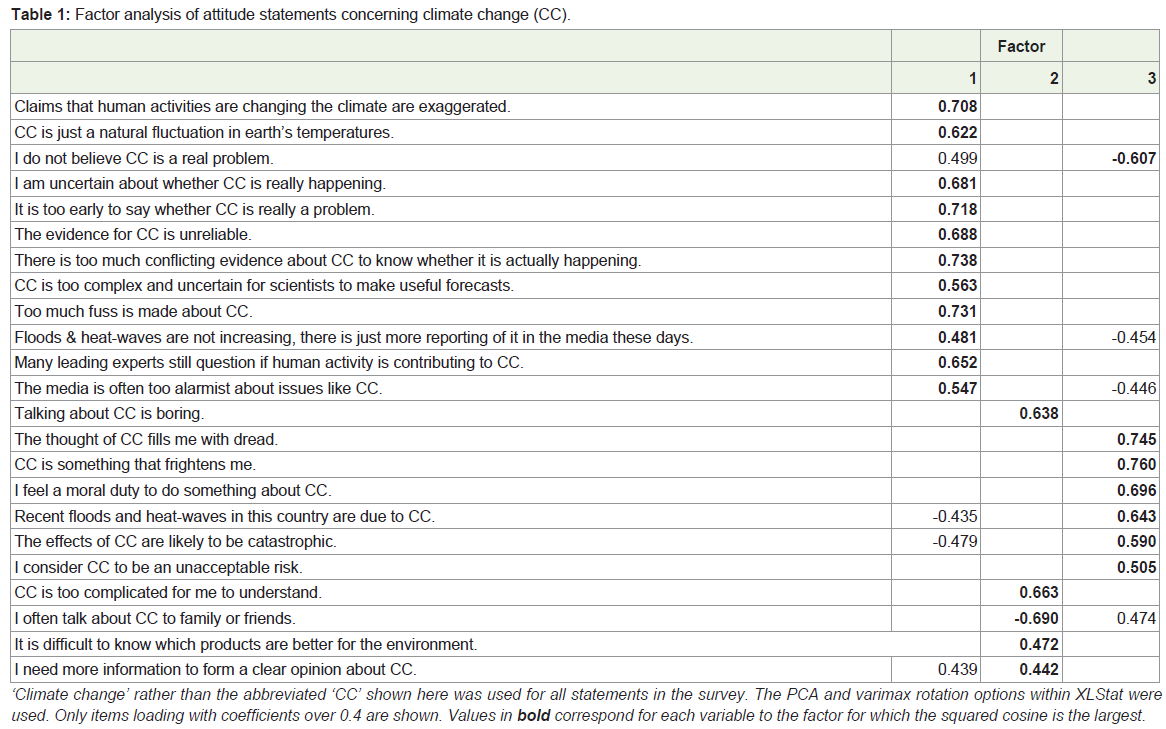

Scepticism:
Table 3 shows total agreement for the 12 individual scepticism statements. Highest agreement was for The media is often too alarmist
about issues like climate change (38% of respondents) and Many
leading experts still question if human activity is contributing to climate
change (37%), while the lowest agreement was for I do not believe
climate change is a real problem (8%). Average agreement across all
scepticism statements is 2.3, which falls approximately halfway on the
scale between disagree a little and neither agree nor disagree.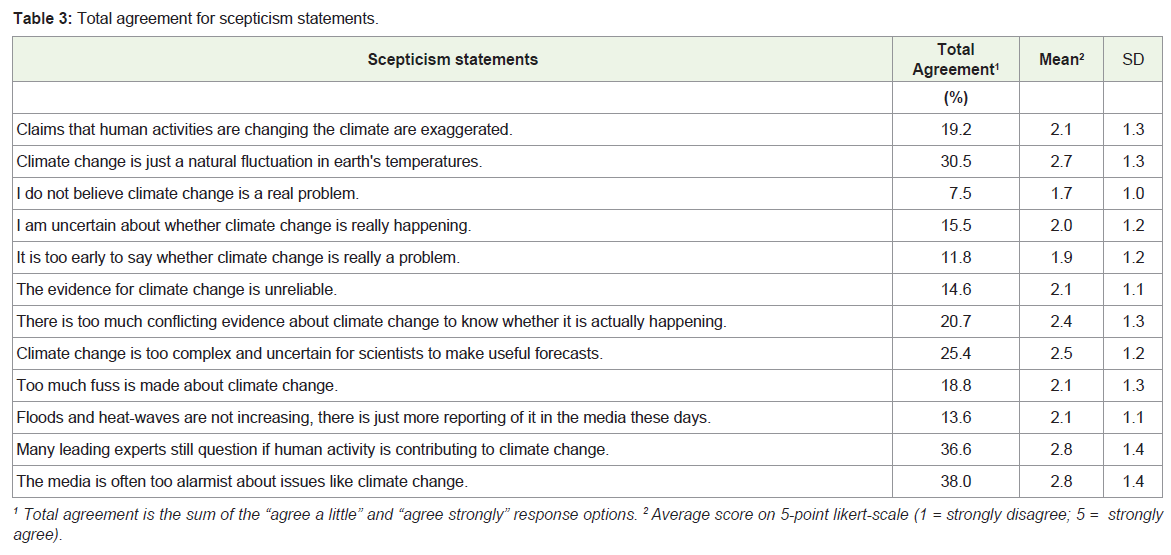
Socio-demographic factors:
The age of respondents was not linearly associated with scepticism
scores (r=-0.00, p=0.99), however one-way ANOVA showed a
significant effect of age categories (F=2.23, p=0.05). Interestingly,
scores of participants aged between 40 and 44 yrs were significantly
higher than for all other age classes (Figure 1 (I)). Scores were not
linearly associated with personal income (r=-0.03, p=0.71), and
one-way ANOVA of the major personal income classes (<$5 000,
$5 000-$24 999, $25 000-$49 999, $50 000-$74 999, $75 000 and
over) showed no effect (F=0.31, p=0.87). Scepticism scores did not
vary with household income when the major income groupings ($0-
$19 999, $20 000-$39 999, $40 000-$59 999, $60 000-$99 999, $100
000-$149 999, $150 000 and over) were analysed (F=0.72, p=0.61),
although significant differences were observed between the two
extreme household income groupings (<$30 000 vs. $150 000 and
over; t=4.45, p=0.04; Figure 1 (II)). Scores from respondents with
three or more children in their households were significantly higher
than for those with two, one or no children (F=3.28, p=0.02; Figure 1 (III)). Respondents whose highest qualification was below a Bachelor
degree were significantly more sceptical of climate change than those
with a Bachelor or graduate degree (t=5.13, p=0.03; Figure 1 (IV)).By contrast, neither gender (t=1.97, p=0.16), rurality (F=1.59,
p=0.21), immigrant status (born in Canada vs. immigrated; t=0.00,
p=0.96) nor highest science qualification attained (F=0.76, p=0.52)
associated with scepticism. With consideration to respondent
location, variation between individual provinces and territories could not be examined due to the low number of responses for many cells.
However, when the wider geographical regions of Western Canada
(British Columbia and Alberta) and Central Canada (Ontario and
Quebec) were compared - which captures the four most populated
provinces and 86% of the Canadian population [28]- respondents
from Western Canada showed significantly higher scepticism scores
(t=5.83, p=0.02; Figure 1 (V)).
Climate change knowledge, environmental values, and political orientation:
Climate change knowledge was assessed by averaging responses
to the questions How much, if anything, would you say you know
about climate change? and How well informed do you consider yourself
on the issue of climate change? Answers to these two questions were
significantly correlated (r=0.72, p<0.0001). To perform ANOVA,
responses were coded as low (1-3.5), moderate (4) or high (4.5-6)
climate change knowledge; no significant effect was found (F=2.43,
p=0.09), although a comparison of the high vs. low knowledge groups
showed significantly higher scepticism scores in the latter (t=4.83,
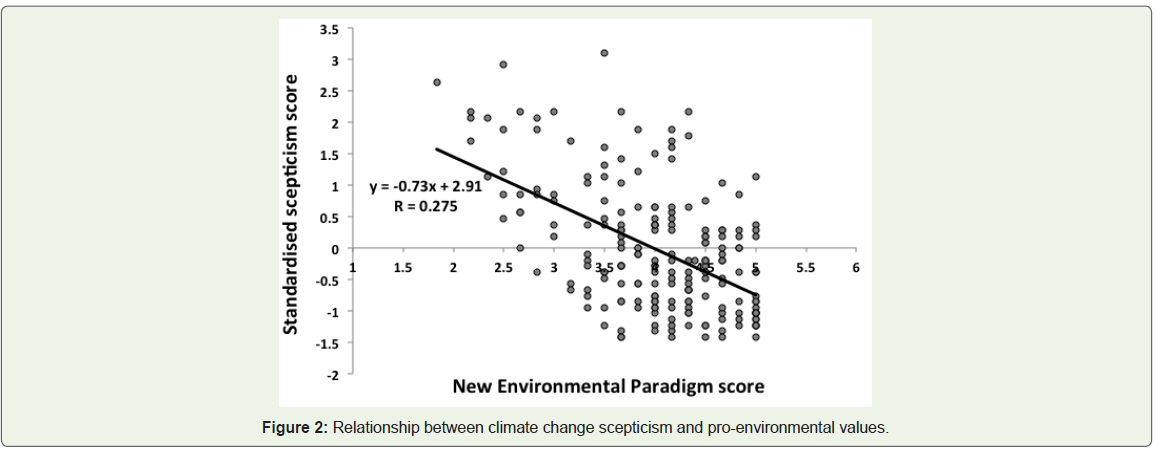
p=0.03; Figure 1 (VI)).The average NEP score in this sample was 3.98 ± 0.72. As
expected, these scores were inversely associated with climate change
scepticism (r=-0.52, p<0.0001; Figure 2), and an analysis of the top
vs. bottom quartiles showed scepticism was substantially greater for
respondents with low NEP scores (t=51.01, p<0.0001; Figure 1 (VII)).
An ANOVA examining political party affiliation (Liberal Party,
Conservative Party, New Democratic Party, Green Party, and Other/
None/Would not vote) showed significantly higher scepticism scores
for respondents identifying with the Conservative Party of Canada
(F=11.00, p<0.0001; Figure 1 (VIII)).
Multivariate analysis:
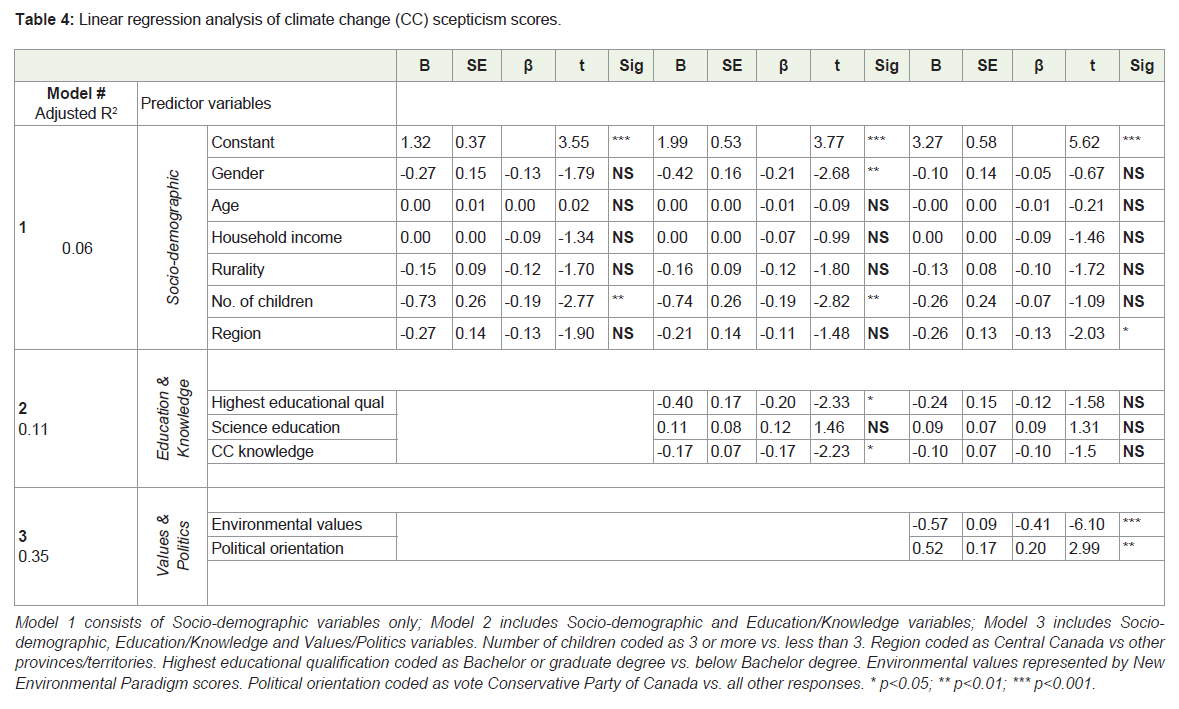
In order to assess the relative contribution to scepticism from
these diverse variables, I followed the approach of Whitmarsh [22] and used linear regression to separately model the socio-demographic,
education/knowledge, and value/politics factors (Table 4). In Model
1, which just considered the socio-demographic measures, number
of children in the household - dichotomised as three or more vs. less
than three - was the only significant variable. When education and
knowledge elements were added (Model 2), both gender and number
of children in the household were significant, with - in the case of
gender - males tending to be more sceptical. Highest educational
qualification attained and climate change knowledge were both
significantly and inversely predictive of scepticism scores. All four
significant variables in Model 2 had comparable effect sizes, as
evidenced by their similar standardised coefficients (β). However, all
four became non-significant when environmental values and political
orientation were added to the model, both of which are highly
predictive. Interestingly, region becomes significant in Model 3, reflective of the lower scepticism of respondents from Central Canada.
The full model accounts for 35% of the variation in scepticism scores
(Table 4). When the three independent variable groups are modelled
separately, socio-demographic variables explain 6% of the variation,
education and knowledge 3%, and values and politics account for 31%,
highlighting the dominant role of environmental values and political
orientation in predicting climate change scepticism in this sample.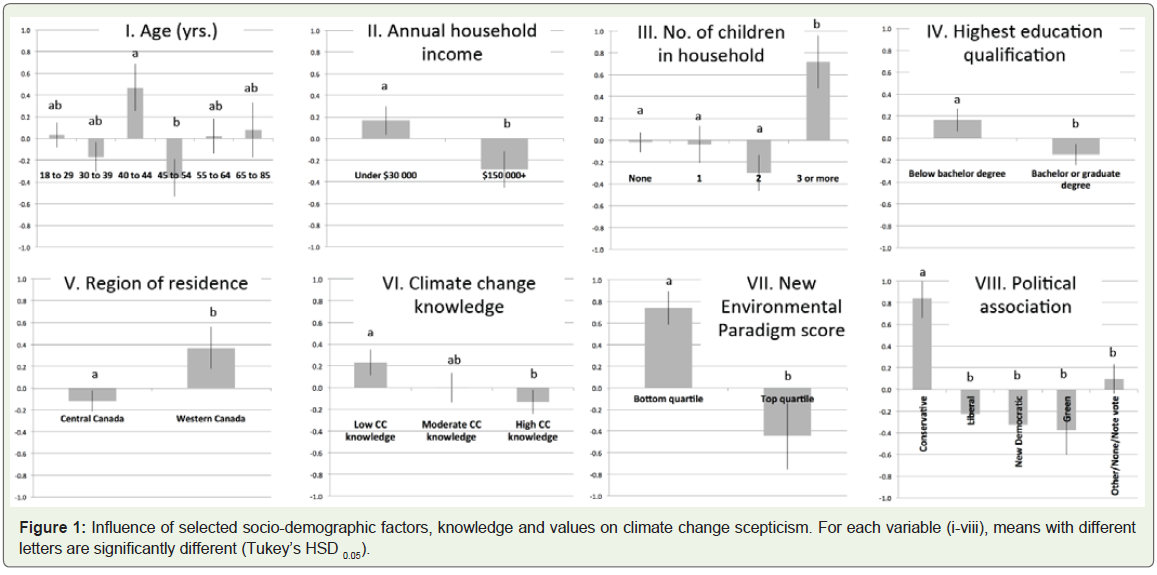
order to test for mediation, the significant predictors were
regressed onto the socio-demographic and education/knowledge
variables (Table 5). Region is associated with highest educational
qualification, with 66% of Central Canada respondents holding a
Bachelors degree or higher compared with 41% in other regions.
Pro-environmental values are positively associated with (female)
gender, and inversely associated with number of children (3 or more).
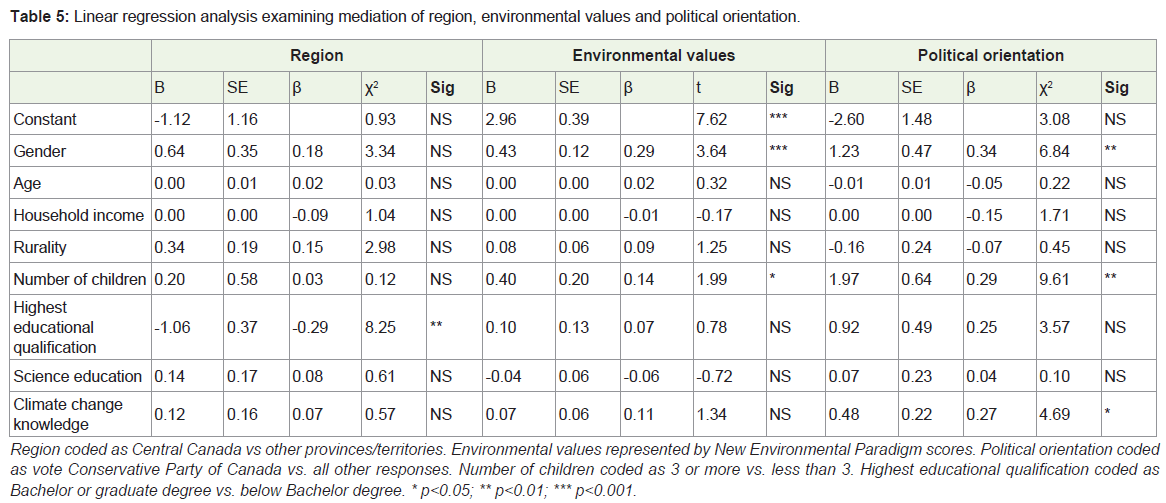
Conservative Party association is positively linked with (male) gender
and number of children (3 or more), while inversely associated
with climate change knowledge. Amongst the mediator variables
themselves, environmental values are predicted by Conservative
Party association (B=-0.79, β=-0.43, t=-6.67, p<0.0001), but not by
region (t=-0.56, p=0.56). NEP scores were 19% lower for respondents
who identified with the Conservative Party compared with all other
responses (t=44.46, p<0.0001).
The most sceptical:
As greater opportunities to affect attitudinal and behavioural
change may exist amongst the more sceptical Canadians, I also
examined their socio-demographic, education/knowledge and
values/politics responses compared to the entire sample in order
to best identify and characterise these individuals. ‘Most sceptical’
was defined as a standardised scepticism score of 1 or greater.
This corresponded to a mean raw score of 3.8 ± 0.5 for this group, compared with 1.9 ± 0.6 for other respondents; they were twice as
sceptical about climate change. Their profile is shown in Figure 3.
The most sceptical were 2.3 times more likely to vote Conservative,
and over 70% more likely to reside in Western Canada. They also had
more children in their household and were most likely to be male. As
expected, the NEP scores of the most sceptical were (modestly) lower
than for the entire sample.Discussion
Regional and international comparisons (H1):
Overall, there appears to be a general acknowledgement that
climate change is a problem, with only 8% agreeing with I do not
believe climate change is a real problem. However, responses to
some of the more nuanced statements are less compelling, with, for
instance, only 44% of respondents disagreeing with the statement
Climate change is just a natural fluctuation in earth’s temperatures.
This apparent discrepancy may be illustrative of multiple constructs
underlying understanding and expression of scepticism by the public
[12]. Some confidence in the robustness of the composite scale used
here, at least with respect to capturing ‘epistemic scepticism’ [12], is
its strong agreement with that derived by Whitmarsh [22] with UK
respondents; the same 12 statements associated with scepticism and
uncertainty also loaded on the first factor of her PCA, and also showed
good internal validity. Also noteworthy in this study are the attitudes
loading on Factors 2 and 3, with statements in Factor 2 reflective of
disinterest and need for information, and Factor 3 broadly capturing
emotional and moral dimensions of climate change risk perception.Heath and Gifford previously surveyed a small sample of
Canadians from British Columbia, and measured belief that global
climate change is occurring [24]. Ecocentrism, environmental apathy, and perceived knowledge were identified as the significant
predictors, with the latter finding in general agreement with the
results reported here (Figure 1 (VI)). The higher scepticism scores
of individuals from Western Canada in the current study may reflect
an attempt to resolve the cognitive dissonance created between proenvironmental
values and wealth aspirations or goals, facilitated
by the economic dominance of the high GHG-emitting oil sands
industry in the region (Section 1.3), similar to the “socially-organised
denial of global warming” in oil-rich Norway reported by Norgaard
[32]. This interpretation is supported by the observation that there
were no differences between the average NEP scores of Western
Canadians and respondents from other regions (F=1.84, p=0.18),
although it requires further testing.
The composite scepticism scale used here has not been widely
applied in other countries, which makes direct comparisons with
other populations more challenging. However, Whitmarsh [22],
using the same index, reported average climate change scepticism
scores in the UK public of 2.7 and 2.9 in 2003 and 2008, respectively,
suggesting modestly higher overall scepticism than observed in this
study, although time frames are obviously different. More recently,
the data of Leiserowitz et al. [18] suggest Americans - Canada’s closest
neighbours - are significantly more sceptical, with, for example, 23%
of USA respondents reporting they do not believe global warming is
happening. Interestingly, the authors also report that this scepticism
increased in the USA during 2013.
Politics and values (H2 &H3):
Conservative political association was a strong predictor of
climate change scepticism in the current study, in agreement with
USA and UK findings [17,33]. This result is likely driven, at least in part, by the lower environmental concern of Canadians holding
conservative political values, which concurs with previous studies
(see 23 for a review). Environmental protection - and via extension,
climate change mitigation – involves government intervention into
free markets, which conflicts with conservative values [34]. Similarly,
individuals with free-market ideology are more likely to believe that
‘the market’ will solve all problems, including environmental, and thus
are more sceptical about climate change [24]. A closer examination of
responses shows a significant interaction between political association
and highest educational qualification attained (F=15.85, p=0.045).
While higher educational attainment (dichotomised as below
Bachelor or above Bachelor degree) associated with lower scepticism
for non-Conservatives, Conservative voters with a Bachelor degree or
higher were more sceptical of climate change than those with lower
attainment (data not shown). This result agrees with the findings
of McCright and Dunlap [34], although it is not due to lower proenvironmental
values in the more highly educated Conservatives, as
suggested by Zhou [23]; the interaction between political orientation
and education was not significant for NEP scores (F=0.71, p=0.40).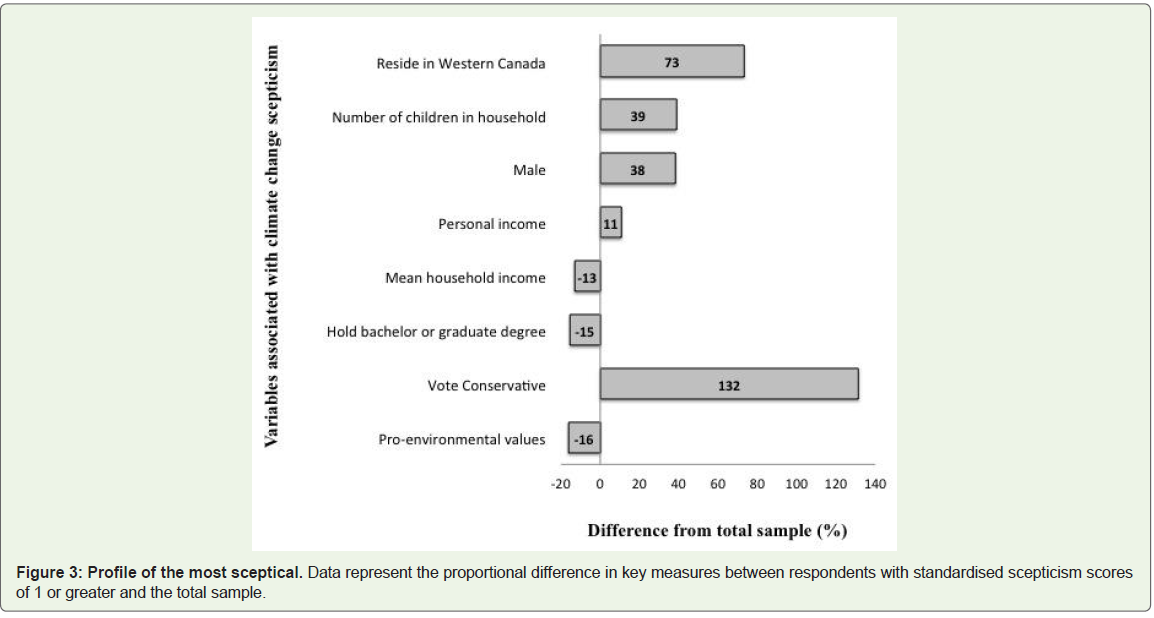
Pro-environmental values were the strongest independent
predictor of climate change scepticism, in concurrence with
Whitmarsh [22]. Notably, the predictive power (β)and direction
of both political and environmental values and their relative effect
size compared with other variables examined are very similar to her
findings for UK respondents, perhaps suggestive that this result might
generalize to other predominantly Anglophone countries as well.
Climate change knowledge (H4):
It is often assumed that a low level of climate change education or
understanding is a major contributor to scepticism and inaction - the
so-called ‘knowledge-deficit model’ [35] - and therefore policy and
other activities are best to focus on public education. However, selfreported
climate change knowledge did not differ (t= 0.30, P=0.58)
between the most sceptical (mean=4.35) and other (mean=4.25)
respondents in this study, and only 1.2% of the overall variance in
scepticism scores was attributable to knowledge of climate change in
this regression model. To the extent that climate change knowledge
is linked to scientific literacy, these findings are consistent with those
of Kahan et al. [36], who did not find support for the hypothesis
that limited scientific literacy and understanding of climate change
underlies public apathy and scepticism. Some caution should be
applied in interpreting our results, however, as objective measures of
climate change knowledge, such as those used by Tobler et al. [37],
were not obtained here.These results suggest there may be a relatively low return on
interventions focused solely or even primarily on climate change
education in Canada. A possible exception may be for Conservative
voters, who report lower overall knowledge of climate change, perhaps
reflective of the current Conservative government’s substantial efforts
to centralize and restrict messaging about climate change and its
impacts and/or simple apathy [24,27].
Limitations and Other considerations:
A limitation of the study is the lower than expected response rate,
and thus relatively small sample size. This reduces confidence in the representativeness of the sample, and may have underpowered some
analyses. While the sample demographics are generally representative
of the Canadian adult population, inclusion of a French version of
the survey to capture more responses from Quebec would have been
appropriate. A larger sampling in the future may enable a robust
segmentation of the Canadian public, similar to the Six Americas
initiative on attitudes and beliefs about global warming in the USA
[33], which may ultimately assist in more targeted and effective
communications around climate mitigation and adaptation.Non-response bias is also an inherent problem in research
that seeks a representative sampling of a population’s attitudes or
behaviour. In this instance, it is possible that Canadians who are the
most sceptical about climate change are those least likely to complete a
survey on climate change perception. A significant financial incentive
for participation in the study was included to try and mitigate this
risk.
As noted by Whitmarsh [22], climate sceptics base their
beliefs on ideology, rather than evidence; a view supported by the
primacy of political association and pro-environmental values in
the current study. Communications strategies based on climate
change ‘education’ are therefore less likely to be effective in the most
sceptical, as the information will be interpreted within the context of
their existing values and worldviews, which are difficult to change.
Instead, climate messaging for this group may be more effective
if framed around other issues, such as energy independence and
security [17]. For the less sceptical, communication campaigns may
be best advised to avoid sensationalism or alarmist approaches, as
many Canadians already attribute the media with such hyperbole on
climate change, and alarmist communication may lead to less public
engagement and lower motivation for mitigation behavior [38].
Finally, structural interventions that foster pro-environmental values
may be an effective long-term strategy in Canada, although further
research is needed to elucidate how climate change communication
and policy can be tailored and optimised, given the diversity of public
scepticism and values.
Conclusion
Scepticism and uncertainty represent potentially powerful
psychological barriers to individuals taking meaningful action on
climate mitigation and adaptation. This exploratory study surveyed a
representative sample of the Canadian adult population to determine
their level of climate change scepticism and how it varies with select
socio-demographic, knowledge/education and value dimensions.
H1 was confirmed: respondents from Western Canada were more
sceptical about climate change than those from the other regions
examined, which may be interpreted as a strategy for resolving
cognitive dissonance between pro-environmental values and wealth
aspirations. H2 and H3 were confirmed: scepticism scores were
negatively associated with pro-environmental values, and were higher
for respondents with a Conservative Party orientation. Indeed, these
two factors were the strongest predictors of climate change scepticism
of all measures assessed. H4 was partially confirmed. While a full
factor regression model failed to identify climate change knowledge
as a significant predictor, scepticism was modestly higher in lowknowledge
respondents compared to high- knowledge respondents. The most highly sceptical of all Canadians are male, Conservative
Party voters living in Western Canada with a greater number of
children in their household.
The baseline data reported here will allow changes in climate
scepticism in Canada to be tracked over time, including evaluation
of the efficacy of various interventions aimed at encouraging climate
change mitigation behaviours. Taken together, these findings
highlight the importance of ideology and values in shaping beliefs
on climate change, and illustrate the heterogeneity of empirical
scepticism in a population, which in turn may underlie variation in
levels of mitigation engagement. This suggests that messaging and
policy strategies on climate mitigation might need to be differentiated
and optimised for different segments of the public.
Acknowledgements
The Environmental Sustainability Research Centre and the
Council for Research in the Social Sciences, Brock University, are
sincerely thanked for funding that supported this project. Samantha
Morris, Dr Ryan Plummer, Hannah Pickering (Brock University),
and Kerrie Pickering (Green Health Global) are thanked for valuable
technical and editorial assistance
Declaration of conflicting interests:
The author declares no potential conflicts of interests with respect
to the authorship and/or publication of this article.References
Citation
Pickering GJ. Head in the (Oil) Sand? Climate Change Scepticism in Canada. J Environ Soc Sci. 2015;2(2): 117.