


Research Article
Effect of Fire on the Viability of Seeds of Acacia seyal Buried in the Soil
Mohamednour Abdelrahim Gasmelseed*
Department of Forestry, Food and Agriculture Organization (FAO), Sudan, Saudi Arabia
*Corresponding author: Mohamednour Abdelrahim Gasmelseed, Department of Forestry, Food and Agriculture Organization (FAO), Sudan, Saudi Arabia; E-mail: mohamednourg@yahoo.com
Article Information: Submission: 25/07/2015; Accepted: 19/08/2015; Published: 22/08/2015
Copyright: © 2015 Gasmelseed MA. This is an open access article distributed under the Creative Commons Attribution License, which permits unrestricted use, distribution, and reproduction in any medium, provided the original work is properly cited.
Abstract
Natural forests of the clay plain of Sudan are continuously decreasing for various reasons including horizontal expansion on cultivation of crops, cutting
for fuelwood and grazing. Then, it becomes more important to mobilize the soil seed bank to restore or reforest the vast cleared areas. Therefore, study was
carried out to provide some information on the impact of fire burning on the soil seed bank of the dominant tree species in central clay plain of the Sudan,
the Acacia seyal, which is frequently devastated by fire.
Seeds of A. seyal with 89% viability were scattered on the soil surface and buried at depths of 5 cm, 10 cm in plots of 1 m2. Each plot was mattresses with dry grass biomass of 0.5, 1.0 and 1.5 kg/m2 to generate fire of various intensities and residence time. The seeds were dug subsequent to firing to count
the recovered ones and test their viability; the lost and charred seeds were also counted.
The percentage of the recovered seeds in the buried plots (71%) was significantly less than those in unburied ones (79%). However, the differences between the plots of various fire intensities were not significant. The germination of all recovered seeds did not exceed 53%, and this percentage decreased as the fire intensity increased. The viability of the recovered seeds decreased from 89% initially to 55% after burning. The percentage of perished seeds was counted as 5% including both the lost (3%) and the charred seeds (2%).
Introduction
Talih (Acacia seyal) is a very important tree species for the
versatile uses of its wood, the leaves and flowers as fodder for animals,
protects and enriches the soil. It occurs in association with Balanites
aegyptiaca in the low rainfall woodland with grass on the clay plains
of central Sudan, where the rainfall is from 500 to 800 mm.
The average growing stock in natural forests at the age of 50 to 60
years is estimated to 24 m³ haˉ¹ and the total above ground volume
about 33 m³ haˉ¹ [1]. Abdel Nour and Satie [2], ElSiddig [3] and Vink
[4] mentioned that the stocking volume in natural productive stands
range between 15 to 45 m³ haˉ¹ at a felling period of 25 years.
Drought in combination with human activities such as cropping,
wood cutting and grazing may affect the vegetation adversely. In Sudan agriculture, particularly shifting cultivation and rainfedmechanized
farming have been expanded at the expense of natural
woodland. Natural forests in the clay plain of Sudan contribute by
76% of the total Sudan energy consumption [5] and this in turn
accelerates the rate of deforestation. On the other hand, grazing in
dry areas depends mainly on leguminous tree species of which A.
seyal is palatable at all stages of its development.
Fire is a major ecological factor in several ecosystems it is
an integral part of the evolutionary forces, which have shaped
these ecosystems. Although it might acted primarily through
species extinction, retaining species with traits adaptive to several
disturbances and not specifically to fire [6]. The biological traits most
influenced are reproductive, which permit a rapid re-establishment
or resprouting and/or germination of seeds after fire [7].
Effective management of some plant communities is dependent
on understanding of seed bank dynamics. Lawton and Putz [8]
investigated the seed bank following slash and burn; their investigation
revealed that most woody vegetations have originated from the seed
bank. However, no plant community is entirely undisturbed. The
scale, severity and timing of disturbances are crucially important.
In general, sense, the role of seed bank in vegetation dynamics is
intimately connected with disturbances such as fire [9]. West [10],
Young et al, [11] concluded that slash and burn reduces the seed bank
to less than 50% of its original size, and about 85% of the surviving
seeds subsequently germinate. The persistence of the seeds in the soil
is a major component of plant succession and plays substantial role in
evolution of plant communities.
Sandbank of A. seyal is relatively small; this is mainly based on
the data from dryland forest ecosystem, which generally seem to have
low number of seeds/m². Such investigations in dryland ecosystems
revealed quite low densities. Mustafa [12] found about 20 seeds/m²
under the canopy of A. seyal in Sudan. However, in Ghana Hall and
Swaine [13] reported 100 to 170 seeds/ m², in Kenya Kaaraka [14]
found a maximum of 6 seeds/ m² under the canopy of Acacia spp.
Dryland ecosystems, in general, seem to have smaller seed banks.
This may be due to seed losses through fire, pathogens or through
germination in response to favorable conditions.
Recruitment of sandbank is restricted to periods with favorable
conditions of soil parameters that may control seed germination.
Recruitment of Acacia seedlings in Sudan is much lower than
mortality and most of the mortality is ascribed to human activities,
recruitment is apparently confined to years with relative high
precipitation [15]. The situation needs efforts and actions to formulate
measures to regulate human pressure on natural forests and to restore
the vegetation.
Materials and Methods
The present study was conducted in flat opened yard at Wad
Medani town (long. 33º 29’ N and Lat. 14º 23’ E). Soil is clay, forming
a network of cracks when drying. It is alkaline and of low permeability
and organic matter content. The mean monthly temperature is
28.3ºC, monthly average of the daily maximum temperature is 37.7ºC
and corresponding minimum is 18.8ºC when measured during the
period of study in November 2002.
Samples of dry grasses were collected from Okalma forest in the
clay plain of Sudan at long 33º 84’ N and Lat 13º 05’ E. The grasses
were clipped at the ground level from five randomly located quadrates
of one square meter in area. Clipping was done in October 2002 to
avoid grazing. Weights of the loops were measured after drying to
calculate the average fuel amount per quadrate, which was found to
be 1.5 kg/ m².
The study was conducted on flat land free of trees. The experiment
was layed out in split plot design. Consisted of four blocks, the soil of
each was ploughed and leveled to ensure its freedom of fuel and seeds,
each block consisted of four plots each of three-square meters in area.
The plot was uniformly covered with 0.0, 1.0 or 1.5 kg of dry grasses.
Each plot was divided into three subplots to incorporate seeds of A. seyal at 0.0, 5 or 10 cm of soil depth. About 250 seeds of initial viability
of 89% were incorporated in each subplot at the prescribed depth.
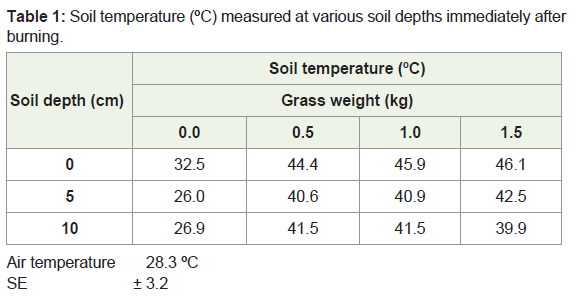
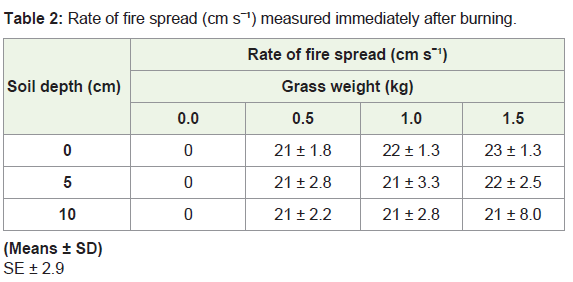
Fire was set in the plot and immediately after burning air
temperature, soil temperature at 0.0, 5 and 10 cm soil depth, rate
of spread (cm sˉ¹) and residence time (sˉ¹) of fire were measured.
Maximum and minimum temperature thermometers, soil
temperature thermometer, measuring tape and stopwatch were used
(Table 1 and 2).
After 48 h from burning, the soil of each plot was collected to the
depth of seed position and sieved for seed extraction and counted.
Recovered seeds were grouped into persistent and perished seeds. The
persistent seeds were those that looked healthy from the appearance,
while the perished seeds were those charred or lost.
Percentage of persistent, charred and lost seeds were calculated
to normalize the variance, the data were transformed to using arcsine
transformation in case of the persistent seeds and root transformation
in case of perished ones. Analysis of variance (ANOVA) was
performed using MSTAT package to estimate the significance of
fire intensity on seed bank at the various soil depths. Means of the
treatments were segregated using studentzed T-test.
Hundred persistent, healthy seeds of no cracks in their coats,
which recovered from each subplot, were treated by (98%) Sulphuric
Acid for five minutes and then germinated on moist filter paper placed
into Petri dishes in the laboratory and watered regularly with distilled
water. The seeds that produced a 1-mm radicle were considered
germinable, daily counted and discarded for a period of one month.
The remaining seeds were first soaked in water for 5 h at 30 °C, then
they opened along the cotyledons attachment to expose the embryo
to the 2-3-5 Triphenyl Tetrazolium Chloride of 1% concentration for
two hours under normal room conditions. The seeds were then taken out of the chemical, washed with water and cut through embryo. The
seeds that showed red colour in their embryo were graded as viable
seeds.
The percentages of germinated and viable seeds were calculated
in each sample. The data were transformed to arcsine values. Then
ANOVA was run in order to estimate the magnitude of effect of each
treatment at various levels. LSD test was used to segregate differences
between the means.
Results and Discussion
Recovered seeds:
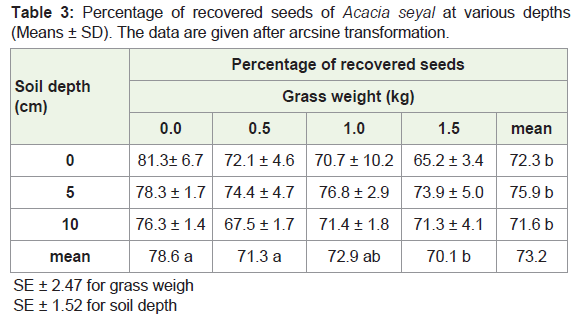
Results of the study showed that after setting fire, about 73% of
the seeds buried in the soil at various depths were recovered (Table 3). Percentages of the seeds recovered from all plots that subjected to
fire were significantly (0.5) less than those recovered from unburned
plots. Relating the percentage of the recovery of the seeds to various
burying depths, the differences between the means were found not
significant (0.5). It was also revealed that the impact of the fire on the
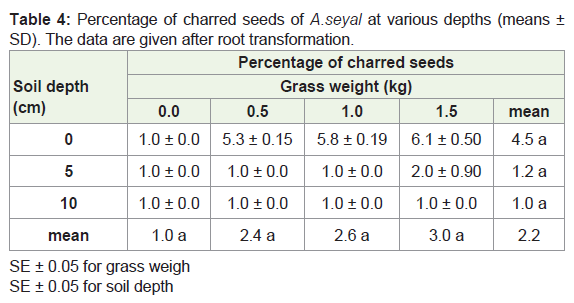
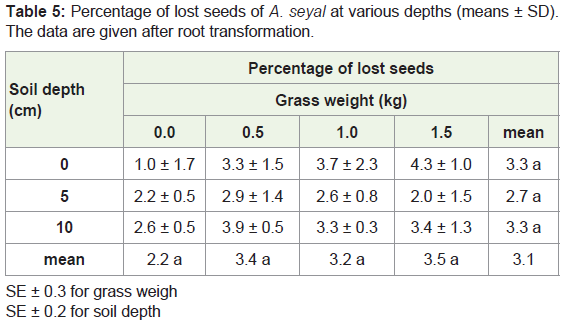
seeds was statistically the same at all depths.About 2% of the recovered seeds were charred as seen by the
naked eye (Table 4). Moreover, 3% of the buried seeds lost (Table 5).
The number of the charred seeds significantly (0.5) increased as the
grass weight increased. The same trend could be seen in the treatment
of the burying depth, but the percentage of the charred seeds at the
top soil (0.0 cm) was four times greater than that in the other depths.
The percentage of the lost seeds increased with increasing soil depth,
this was mainly attributed to the presence of soil cracks below 10 cm
depth which made some of the seeds went deep in the soil, but the
differences between the means were not significant (0.5).
Germination and viability of the recovered seeds:
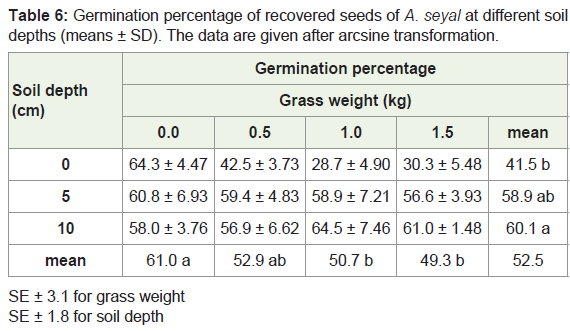
Table 6 showed that the germination percentage of the recovered
seeds did not exceed 53%. It decreased as the fuel mass increased,
but the differences between the means were not significant. However,
the germinability of the seeds found on the top soil was significantly
(0.5) reduced by fire compared to the means of the seeds in other soil
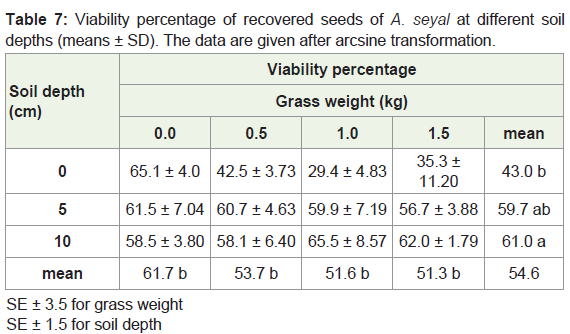
depths.The conducted physiological test by germination and tetrazolium
showed that the viability of t he recovered seeds decreased from 89%,
(initial viability), to 55% (Table 7). The viability of the seeds found on
soil surface was significantly (0.5) reduced compared to that of the seeds buried at various soil depths, but the increase in soil depth did
not cause a significant reduction in the viability of the seeds.
In this study, it was proved that fire has damaged some of the seeds. This goes with results of many investigations that fire may
shape the vegetation pattern [6]. The damage of A. seyal seeds by fire
should be taken into consideration, together with the fluctuation of
the seed production when planning for plantation establishment.
Seed production in A. seyal fluctuates from one year to another due
to the unstable environmental conditions of the dryland.
The result of this study are in agreement with the finding of
Hassan and West [10] who stated that fire damages the seed stored
on the soil surface. The greater the fuel mass the hotter the fire and
then more seeds would be burned. It was clear in this study that the
effect of fire was confined to the top layer of the soil. This suggests
that a significant damage may need more fire residence to permit the
conductance of heat deep into the soil to produce adverse effects on
the seeds. Although only about 2% of the seeds had been burned or
charred, this amount is large enough if we know that about 95% of
the seeds incorporated in the soil could be depleted by germination
and suffocation within three years (Mustafa 1997). Another point
supporting the danger of fire on the soil seedbank is that the damage
is confined to the soil surface, which embodies the potential soil
seedbank that would be developed into plants.
In the present study the viability of the seeds buried at all depths
decreased by 34% after fire incidence. The significant reduction
occurred in the viability of the seeds broadcasted on the soil surface,
is strongly supported by the finding of Young et al, [11] who assured
destruction of the seeds on top of soil surface by fire, and the effect
will be so serious if the fire is severe and resident for long time.
This study showed that fire has decreased the germinability of
the seeds of A. seyal particularly those on top of the soil. This could
be attributed to the fact that fire may cause damage to the embryo;
moreover, it was found that the germination of seeds extracted from
burned plots was lower than that of unburned seeds. Many plant
species have seeds, which require heating or other means of seed coat
scarification for germination. Mustafa [12] has stated that the seeds of
A. seyal have coat-imposed dormancy that may maintain the viability
of the seeds for long time waiting favorable conditions to germinate.
However, germination of the dormant seeds is somehow difficult
unless their dormancy is broken. Naturally, this brought about by
many biotic and abiotic factors such as temperature and pathogens.
However, this study revealed that the heat released from high fuel burning have reduced germination of the seeds particularly those on
the soil surface, compared to the germination of the seeds recovered
from other soil depths.
References
Citation
Gasmelseed MA. Effect of Fire on the Viability of Seeds of Acacia seyal Buried in the Soil. J Environ Soc Sci. 2015;2(2): 115.