


Research Article
Ethnomedicinal Uses of Host Plants of Wild Silk Moths in Mizoram
Esther Lalhmingliani1*, G Gurusubramanian1, N Senthil Kumar2, Ruth Lalfelpuii2, HT Lalremsanga1 and Samuel Lalronunga3
1Department of Zoology, Mizoram University, Aizawl - 796004, India
2Department of Biotechnology, Mizoram University, Aizawl - 796004, India
3Department of Environmental Science, Mizoram University, Aizawl - 796004, India
*Corresponding author: Dr. Esther Lalhmingliani, Assistant Professor, Department of Zoology, Mizoram University, Tanhril-796004, Tel: 9436195943/85745475947 (M), India; Email: es_ralte@yahoo.in
Article Information: Submission: 14/07/2015; Accepted: 12/08/2015; Published: 18/08/2015
Copyright: © 2015 Lalhmingliani E, et al. This is an open access article distributed under the Creative Commons Attribution License, which permits unrestricted use, distribution, and reproduction in any medium, provided the original work is properly cited.
Abstract
The paper deals with the host plants of wild silk moth of Mizoram having ethno medicinal values. The study provides medicinal usage of 22 species of the
host plants of wild silk moths belonging to 14 families. They are listed along with their scientific name, local name, family, part used, methods of preparation
and types of ailments treated. Documenting the indigenous knowledge through ethno botanical studies is important for the conservation and utilization of
biological resources. This will not only safeguard our forest but would have direct impact on the conservation of food plants of different wild silk moths to
ascertain the continued existence of these valuable entomofauna among other components of biodiversity.
Keywords
Wild silk moths; Host plants; Ethnobotany; Mizoram
Introduction
The use of plants and animals as a source of medicine and food
is as old as humanity. Ethno medicine or herbal medicines are in
great demand in both developed and developing countries like India
in primary health care because of their great efficacy and little or no
side effect [1]. According to the studies on ethno medicine and folk
medicine, about 2000 species of plants have been newly identified as
drug yielding plants and are well known for their use in about 4000
drug industries of various Indian system of medicine. It is estimated
that about 7500 plants are used in local health traditions in mostly
rural and tribal villages of India. Out of these the real traditional
medicinal value of over 5000 plants is either little known or hitherto
unknown to the mainstream population [2].
Arora reported that over 16000 species of higher plants are known to occur in India and out of these 9000 are economically
useful whereas 7500 of these species are reported to be used for health
care by various ethnic communities in India [3]. India officially
recognizes about 2500 plants as having medicinal value and it has
been estimated that over 6000 plants are used in traditional, folk
and herbal medicine. The number of medicinal plants in India both
indigenous and introduced has been variously put between 3000-
3500 species of higher plants. About 255 of the drug prescribed
worldwide come from plants, 121 such active compounds being in
current use. Of the 252 drugs considered as basic and essential by
World Health Organization (WHO), 11% are exclusively of plant
origin and a significant number are synthetic drugs obtained from
natural precursors [4]. More than 80% of world’s population mostly
in poor and less developed countries depend on traditional plant
based herbal medicines for their primary health care needs [5,6]. The north eastern region of Indian sub-continent harbours 50% of the
plant wealth of India [7]. Mizoram is included under “Indo Myanmar
Hotspot” and is very rich in the resource of folk medicine. According
to the reports made by Lalramnghinglova [8], it is inferred that 95% of
the rural population of Mizoram rely on traditional herbal medicine
and 98% of raw materials are harvested from the wild plant resource
or biological resources.
Wild silk moths belonging to the order Lepidoptera, family
Saturniidae comprises of about 1861 species in 162 genera and 9 sub
families [9,10]. They include such Lepidoptera as the giant silk moths,
royal moths and emperor moths. Wild silk moths can be either
univoltine or multivoltine depending on the geo-climatic conditions
and are distributed in both temperate and tropical region [11]. The
wild silkworms are polyphagus and feed on a wide variety of plants
some of which have ethno medicinal value. They migrate from one
area to another and breed continuously throughout the year.
Description of the study site:
Mizoram is the southernmost state in North-east India bounded
by Myanmar in the east and Bangladesh in the west, and by states of
Tripura, Assam and Manipur in the North. Mizoram falls under the
Indo-Burma biodiversity hotspot [12,13] and is rich in wild flora and
fauna, both in variety and abundance [14]. It has an area of 21,081 sq
km and lies between 21° 56´ N -24° 31´ N latitude and 92° 16´ E - 93°
26´ E longitudes. The topography of the state is characteristically hilly
and the altitude varies from 28-2156 m from sea level. Vegetation is
tropical forest and semi- evergreen forest according to Champion and
Seth [15]. Three distinct seasons are observed in Mizoram viz. cold or
winter season from November to February, warm or spring season
from March till mid of May and rainy or summer season from second
half of May to October [16].Materials and Methods
Surveys were conducted throughout Mizoram from 2012-2014
to document the diversity of host plants of wild silk moths so as to
study their possible ethno medicinal value. Extensive literature survey
was done to collect information on the traditional use of the plants.
Information on local name of medicinal plants, parts used, mode of
preparations, routes of remedy administration were also recorded
by consulting local traditional practitioners, elders and patients who
were associated with the traditional healers from different parts of the
state. Identification of the plants was done with the help of existing
literatures, published books and specialists on the subject from
Botanical Survey of India, Shillong [8,17-21].
Results and Discussion
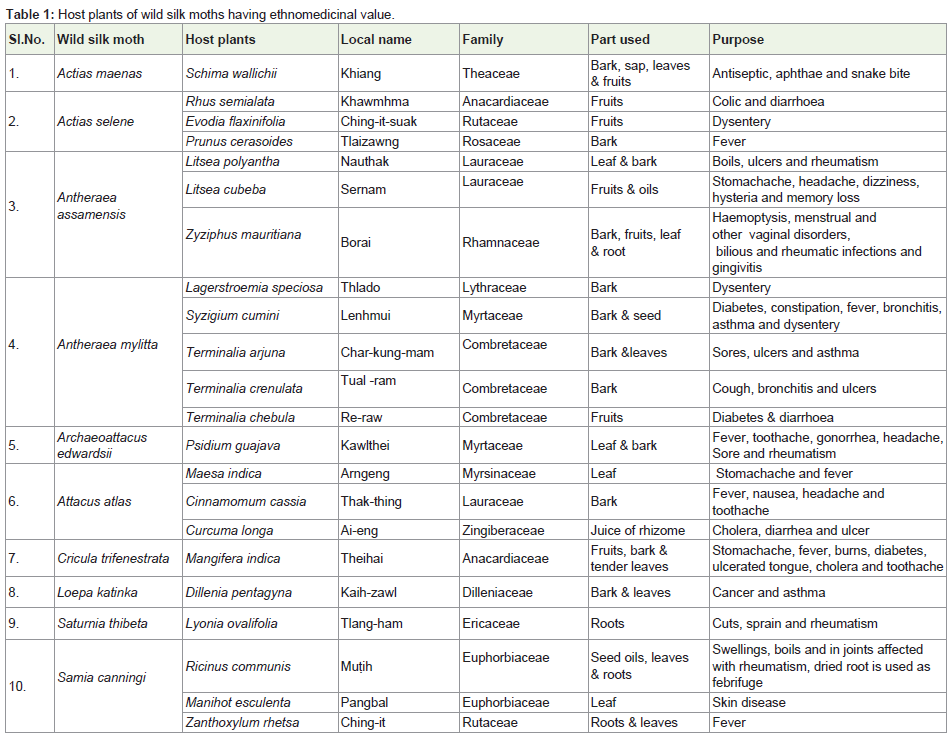
The study revealed the ethno medicinal usage of 22 species of host
plants of wild silk moths. All the plant species recorded during the
study period are listed along with their scientific name, local name
(mizo), part or parts used in the preparation and medicinal uses
(Table 1).
A brief description of host plants of wild silk moth having ethno
medicinal value is given below [8,17-21].
Cinnamomum verum:
An evergreen aromatic tree, upto 18 m tall, with smooth grayish bark. Leaves red when young. The dried bark and buds are used as a
spice.Distribution: Common throughout Mizoram
Part used: Bark
Mode of used: Decoction of the bark is useful for cancer, asthma,
diarrhoea and vomiting.
Curcuma longa:
A perennial herb with bright-yellow tuberous rhizomes. The
young flowers are eaten as vegetables.Distribution: Common throughout Mizoram
Part used: Rhizome
Mode of used: Juice of the rhizome is used in cholera, diarrhoea,
stomach ulcer and asthma.
Dillenia pentagyna:
A middle-sized tree with very large leaves. It is a light demander
and fire resistant. Growth moderately fast.Distribution: Keifang and Maite.
Parts used: Bark & leaves.
Mode of used: Decoction of the bark and leaves is used for curing
gastric problem, asthma and cancer.
Evodia flaxinifolia:
Small to middle sized evergreen tree, strong smelling of caraway
when bruised.Distribution: Ruallung, Sialsuk, Chalfilh, Durtlang etc.
Part used: Fruit
Mode of used: The fruit is antipyretic and is used for treating
dysentery.
Lyonia ovalifolia:
A small tree with thick brown bark. Wood light reddish brown,
soft.Distribution: 900 - 1500 m.
Part used: Roots
Mode of used: Decoction of roots is used for cuts, sprain and
rheumatism.
Litsea polyantha:
Medium-sized tree, bark dark grey; leaves alternate, obovate:
flowers pale greenish- yellow; fruits ellipsoid, seated on sauce- shaped
perianth tube.Distribution: Frequent throughout Mizoram, in tropical
evergreen and semi-evergreen forests.
Parts used: Leaf & fruit
Mode of used: Leaf paste is applied on boils, ulcers and the fruit
is used in rheumatism.
Litsea cubeba:
Small tree with greenish bark, aromatic.Distribution: Frequent throughout Mizoram, up to 1800m
Part used: Fruits
Mode of used: Raw fruits are used to treat stomachache, headache,
dizziness, hysteria and memory loss.
Lagerstoemia speciosa:
Moderate-sized tree; bark grey; leaves ovate or elliptic – lanceolate;
flowers large, conspicuous, mauve- purple in terminal pyramidal
panicles up to 45cm long; fruits ellipsoid or sub- glubose.Distribution: Frequent, in tropical wet evergreen and semievergreen
forests, fairly frequent in South – western part of Mizoram.
Also cultivated as ornamental plants.
Parts used: Bark & root
Mode of used: Decoction of root is taken for jaundice. Bark
infusion is taken orally for diabetes, diarrhoea and dysentery.
Mangifera indica:
Evergreen trees up to 15 cm; leaves oblong lanceolate; sepals
ovate, hairy on back; petals oblong, white; disc 4-5 lobes.Distribution: Common throughout Mizoram
Parts used: Fruits, bark & tender leaves
Mode of used: Bark is made into paste, mixed with water and
is used to treat stomachache and fever. Tender leaves are dried and
made into powder which is used for treating diabetes. Ashes of the
leaves are good remedy for virus, burns and scalds. Gum is used
for treating toothache. Stem and leaf powdered together is good for
ulcerated tongue. Rind of unripe fruit mixed with curd is used for
treatment of cholera. Cold water extract of the leaf was also used for
diarrhoea and dysentery.
Manihot esculenta:
A sub- herbaceous shrub with large tuberous roots and milky
juice; Leaves alternate, palmately lobed, long petioled; flowers
large monoecious in racemes males above, females below; calyx campanuate 5 lobed; petals absent; stamens 10 in two whorls. Also
cultivated for tubers.Distribution: Common throughout Mizoram
Part used: Leaf
Mode of used: Juice is used as a remedy for skin disease.
Maesa indica:
Evergreen shrub or small tree; berries pinkish white.Distribution: Common throughout Mizoram
Part used: Leaf
Mode of used: Decoction of the leaves is used for bath in case
of fever during convalescence. Tender leaves are used to treat
stomachache.
Psidium guajava:
A small evergreen or sub- deciduous tree with smooth pinkish
brown bark exfoliating in thin flakes; leaves opposite oblong or
elliptic oblong; flowers white; berry globose or pyriform varying in
size and shape.Distribution: Common throughout Mizoram
Parts used: Leaf & bark
Mode of used: Decoction of bark is used for stomachache,
fever, headache, gonorrhea, menstrual disturbances and sores. The
young leaves are used as tonic in diseases of digestive function.
A decoction of young leaves and shoots is prescribed as febrifuge
and antispasmodic baths. The pounded leaves are locally applied in
rheumatism. A decoction of the leaves is used as gargle to relieve
toothache and gum boils.
Prunus cerasoides:
A moderate sized tree. Wood red, scented, moderately hard and
durable.Distribution: Common throughout Mizoram.
Part used: Bark
Mode of use: Decoction of bark is used in fever.
Ricinus communis:
A tall glabrous annual, sometimes shrubby or subarboreous;
leaves alternate, broad, palmate 7 to many lobed; flowers serrate, large
in terminal sub- panicled racemes.Distribution: Common throughout Mizoram
Parts used: Seed oil, leaves and roots
Mode of used: Oil is used as purgative. Leave are warmed and tied
as bandage on swellings, boils and in joints affected with rheumatism.
Dried root is used as febrifuge.
Rhus semialata:
Small tree, leaves imparipinnate; leaflets 4-6 pairs, opposite,
dentate, triangular or elliptic ovate; flowers numerous, greenish white or pale yellowish- green; fruits sub- glubose or orbicular, compressed,
green when young, red brown when ripe.Distribution: Common throughout Mizoram between 500 and
1200 m asl.
Part used: Fruits
Mode of used: The fruits are grinded and mixed with water and
the mixture is used to cure colic and diarrhoea.
Schima wallichii:
Medium size to large evergreen tree, young shoots silky pubescent;
branches lenticellate; bark dark grey or brown with deep vertical
cracks and small thick angular plates; leaves oblong-lanceolate or
obovate, acute or acuminate, flowers white, fragrant, solitary, axillary
on lenticellate pedicels; stamen yellow.Distribution: Common throughout Mizoram, from tropical
evergreen to sub- tropical hill forest
Parts used: Bark, sap, leaves and fruits.
Mode of use: Juice of crushed bark is applied externally on cuts
and wounds as an antiseptic. The sap is used for aphthae. Decoction
of dry fruits is taken orally as an effective remedy against snake- bite
and the juice of crushed leaves is also prescribed for snake bite.
Syzigium cumini:
Middle size or large evergreen tree with oblong or ellipsoid
berries.Distribution: Common up to 1500 m
Part used: Bark
Mode of used: Decoction of bark is used to treat constipation,
fever, jaundice, urinary problem, asthma and dysentery.
Terminalia chebula:
A middle-sized tree with ellipsoid or obovoid 5 ribbed fruits.
Wood brownish grey, very hard, durable.Distribution: Ascending to about 1500 m
Part used: Bark
Mode of used: Fruit is used for treatment of diabetes, diarrhoea
and dysentery.
Terminalia arjuna:
A large almost evergreen tree. Leaves sub-opposite, 7.5-14.5 x
3-9 cm, oblong, coriaceous with 2 glands at base, obtuse or rounded
at apex. Flowers yellowish-white, in pedulous, axillary and terminal
spikes; bracteolates linear. Fruits ovoid or oblong, fibrous, woody
5-winged.Distribution: Introduced and planted along roadside.
Parts used: Barks & leaves.
Mode of used: Bark and leaves are used in treatment of sores,
ulcer, asthma, wounds etc
Terminalia tomentosa:
A moderate size or large deciduous tree.Distribution: Thenzawl, Mamit, Kawrthah, Bunghmun, Sesawng,
Thenhlum.
Part used: Bark
Mode of used: The bark is used in cough, bronchitis, ulcer,
diarrhea and dysentery.
Zyziphus mauritiana:
A small or middle sized, much branched deciduous tree armed
with stipular spines.Distribution: Common, ascending to an altitude of about 1,500
m.
Parts used: Bark, fruits & leaf
Mode of used: Fruits is prescribed for haemoptysis, menstrual
and other vaginal disorders, for bilious and rheumatic infections. A
decoction of bark is used as an astringent in gingivitis. A decoction of
leaves is prescribed for loss of voice, giddiness and for piles.
Zanthoxylum rhetsa:
A small to average sized evergreen tree; trunk, shoots and
petioles armed with recurved prickles, strongly pungent smell; leaves
imparipinnate; leaflets 5-10 pairs, oblong lanceolate, oblique at the
base; flowers greenish-white in trichotomous cymes in large terminal
panicles; fruits globose, reddish, rugose.Distribution: Common, in tropical evergreen and semievergreen
forest.
Part used: Roots
Mode of used: The roots are grinded, mixed with water and is
used to treat fever.
Discussion
The present study provides medicinal usage of 22 species of the
host plants of wild silk moths belonging to 14 families. These plants
were used for the treatment of different diseases like burns, diabetes,
dysentery, skin disease, rheumatism, cholera, fever, digestive
disorders, constipation and other common ailments. Most of these
plants were utilized in fresh state as decoction, paste, juice, etc. A
detailed study on the chemical constituents of these plants is a must
so as to investigate their pharmacological effect. Documentation
and scientific surveying of the flora and fauna from any area is
indispensable to any scientific study and conservation program.
Ethno botanical plants are now under threats due to increasing
urbanization, clearing of forest due to shifting cultivation, population
explosion and unplanned exploitation. Therefore, urgent attention
to create public awareness about the conservation of medicinal plant
resources for sustainable utilization is needed which will help in
maintaining the ecosystem. Documenting the indigenous knowledge
through ethno botanical studies is important for the conservation
and utilization of biological resources. This will not only safeguard
our forest but would have direct impact on the conservation of food plants of different wild silk moths to ascertain the continued
existence of these valuable entomofauna among other components
of biodiversity.
Acknowledgement
The financial assistance provided by Central Silk Board, Ministry
of Textiles (Govt. of India), Bangalore, is highly acknowledged.
Authors sincerely appreciate various people for their help and cooperation
during field collection. Gratitude also goes to the Head,
Department of Zoology, Mizoram University.
References
1. Trivedi P C (2006) Medicinal plants: Ethnobotanical approach. Agrobios
(India) Pub Jodhpur India.
Citation
Lalhmingliani E, Gurusubramanian G, Kumar NS, Lalfelpuii R, Lalremsanga HT , et al. Ethnomedicinal Uses of Host Plants of Wild Silk Moths in Mizoram. J Environ Soc Sci. 2015;2(1): 113.