


Review Article
Fish Environment of Garhwal Himalaya- A Socio- Economic, Religious and Cultural Analysis
Kusum Dobriyal1 and Anoop Dobriyal2*
1Department of Sanskrit, HNB Garhwal University (A Central University), Pauri Garhwal-246001, Uttarakhand, India
2Department of Zoology, HNB Garhwal University (A Central University), Pauri Garhwal-246001, Uttarakhand, India
*Corresponding author: Dr. Anoop Dobriyal, Department of Zoology, HNB Garhwal University (A Central University), Pauri Garhwal-246001, Uttarakhand, India, E-mail: anoopkdobriyal@rediffmail.com
Article Information: Submission: 03/06/2015; Accepted: 01/07/2015; Published: 19/07/2015
Copyright: © 2015 Dobriyal K, et al. This is an open access article distributed under the Creative Commons Attribution License, which permits unrestricted use, distribution, and reproduction in any medium, provided the original work is properly cited.
Abstract
Fish has a sacred place in Indian culture since time immemorial. It is honored as an incarnation of Lord Vishnu, cultured at home in aquarium to get rid
of stress and have a peace of mind, reared in ponds and rivers for protein rich diet, becomes a cheap source of food for needy and poor rural folk and also
has been an important source of economy to the country. A socio-economic, religious and cultural aspect of Garhwal region of Uttarakhand was under study
for a period of two years. Apart from various issues like historical development in functioning of society, cultural changes and economic source alterations,
certain issues were taken up which were observed to have greatest impact on human life of this region. In present communication one such issue, “Fish
environment of Garhwal Himalaya- a socio-economic, religious and cultural analysis” has been taken up for discussion.
Keywords
Fish; Fishery; Environment; Economy; Culture; Problems; Perspectives
Introduction
Fish is worshipped as GOD in ancient Indian (Hindu) literature.
It has been believed that God Vishnu’s first incarnated on earth
was as a fish - God Matsya for the welfare of people. The story is
like this that during early days of shrishti (earth) a demon named
as Hayagreeva theft all important ancient literature and hide
beneath earth (Patal Lok). To save the earth and all important
ancient literature, Lord Vishnu has to incarnate as Lord Matsya.
During this passage he narrated several knowledgeable and
educative stories which were compiled in 291 chapters in the
form of “MATSYA PURAN” [1,2]. Many of the stories are related to
conservation of nature and natural resources. It has been stated
and scientifically proved that just by keeping an aquarium in
your house you may skip many stressful diseases like high blood
pressure, insomnia, body pain, etc. [3,4]. According a scientific study [5] in 2009 conducted on the patients diagnosed with
Alzheimer’s disease , it was observed that the patients exposed to
the aquaria averaged an increase of 17.2 percent in the amount of
food they consumed. Weight also increased significantly, and the
patients required fewer nutritional supplements. The engineers
of Vaastu shashtra believed that aquarium flashes out all negative
aspects of Vaastu by producing high positive energy [6].
The medicinal value of fish is well established. It is rich
in protein, vitamins, minerals and the leonelic acid which
is considered good for cardiac health. In Garhwal region a
considerable rural population falls below the poverty line
and suffers from malnutrition. However fish which is cheaply
available for them provide them certain relief. In present paper
village life of Garhwal region in India, the wetland ecosystems,
fish population dynamics and related socio-economic and
cultural aspects are discussed here onwards.
Depiction of Fish in Religious Literatures
Vedas are considered as the most ancient literature of human
civilization, roughly estimated as about 8000 years old. The
fish is discussed in several occasions for different references
[7] (Rigveda-7.18.06, 10.68.8,; Athrvaveda- 11.2.25; Yajurveda-
24.11; Matsyapuran-24.41; Ramayana-3.73.15, 2.80.21;
Mahabharata- Shanti parva, 265.09; Matsyapuran- 252.2, 285.6;
Bhagwatpuran- 1.15.25). Diversified nomenclature of fish in
ancient literature is indicative of different species (Shalki, Pathir,
Pathin, Meenasi, Visar, Animesh, jalchar, timidwaya, Neerniketan
and paneeyniket, etc). In Amarkosh (1.10.17-20), the name of fish
are given depending upon their specific characters [2]. These are
Matsya (Madyati iti matsya- means as fish gives you pleasure- it
is matsya), Jhash (Jhash hinsharthah-as it feeds on other fishes),
Rohit (Raktawat- blood coloured), Singhatundah- due to lion
mouth shaped and Mahashalka (Large scales- which we today
call mahseer), etc.
Garhwal Region and its Rural Life
Garhwal region is situated between the latitudes 29o 26-َ
31o 28 N and longitude 77o 49 - 80o 06 E with a total area of
about 30,090 km2. Most of the holy rivers owe their origin to the
snow peaks of Chamoli and Uttarkashi Districts. Major rivers
are Alaknanda, originating from around Badrinath, Mandakini,
originating from around Kedarnath, Bhagirathi from Gomukh-
Gangotri, Pinder from Pindari glacier and many more spring fed streams. The pious Ganga is formed by the confluence of
Alaknanda and Bhagirathi at Devprayag. All these stream are rich
in fish and other aquatic biodiversity.
The rural life is hard in Garhwal region. Villages are mostly
situated nearby rivers or small stream for routine requirement.
Agriculture do not support the entire need of people. Males of the
family usually go outside for job work so that they can earn money
and send to their family. In terms of economics it is referred as
money order economy. Women of the family are hard working.
Entire agriculture work is look after by them. Apart from this
they rear animals (cow, buffaloes, oxen, goats and sheep’s) and
equally contribute to the family economy. Location of most of the
villages is so close to water bodies that the children mostly catch
some fishes for their routine food requirement. In some families,
one of the male members is doing a regular job of collecting fish.
Wetlands of Garhwal
As already stated the Garhwal region is full of natural aquatic
ecosystems. According to Dobriyal [8] there are two types of
stream in the region. The Snow-fed streams are Alaknanda,
Bhagirathi. Bhilangana, Mandakini, Pinder, Nandakini,
Vishnuganga, etc. These rivers have low water temperature and
high velocity of water current [9-13]. The spring-fed streams are
Nayar, Khoh, Mandal, Song, Suswa and hundreds of their minor
tributaries. Various aspects of ecology of these streams are
studied [14-16].
Fish Population and Food Value
Garhwal hillstreams are full of aquatic life including fishes.
The coldwater streams are enriched by schizothoracine and
golden mahseer fishery while the spring fed streams are rich
with minor carps, loaches and catfishes [7,817,18]. Available
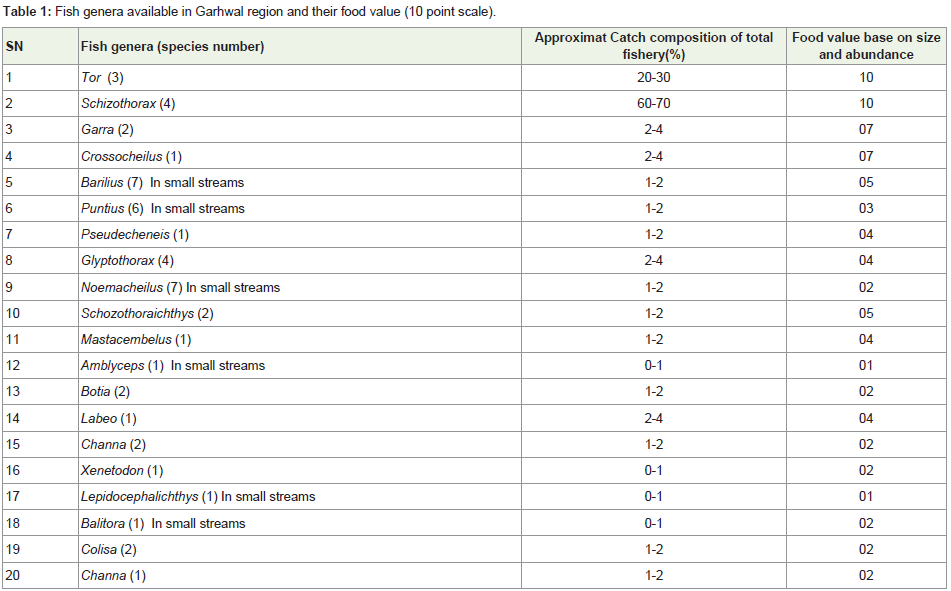
fish genera and their number of species along with food value is
presented in Table 1. Schizothorax sp (snow trout) is the major
fishery of region which contribute to about 70 % in quantum. Tor
fishery makes 2nd position being about 25 % in catch quantum.
Crossocheilus and Garra are prominent among others [19].
Ecological Problems due to Anthropological Activities
The colourful fish fauna of these streams is under great threat
due to some human activities. Most important one is the damming
of the rivers at regular interval for power generation. This has
altered the ecology of streams at a larger area. The feeding and
breeding grounds of fishes are under destruction. Mahseer is a
potamodromous fish which locally migrates from large coldwater
rivers to upward spring fed stream for spawning. The unscientific
dam planning has hampered the mahseer population. Another
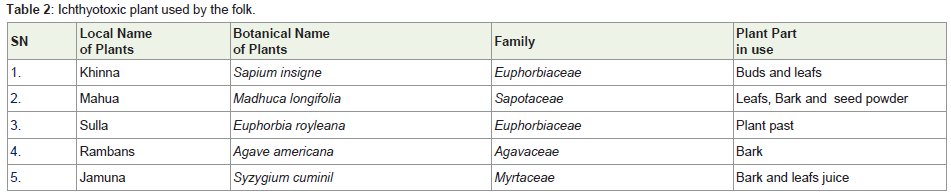
issue is of overfishing. Illiterate folk uses various unscientific
means of fishing like use of bleaching powder, electric shocks and
toxic plants Table 2. This is doing great loss to fishery. Some
university researchers are running some ecological awareness
programs but the intervention or action at Government level is
urgently required.
Possibilities for Conservation
It is required to make in-situ and ex-situ conservation of
aquatic biodiversity. Migration passage should be allowed while
damming the stream. Overfishing should be completely banned.
Fish hatcheries and nurseries be established at the river banks.
Induced breeding programmes through use of new generation
drugs (Ovaprim/ovatide etc) are necessary. And finally extensive
ecological awareness program is needed to be launched.
References
Citation
Dobriyal K, Dobriyal A. Fish Environment of Garhwal Himalaya- A Socio-Economic, Religious and Cultural Analysis. J Environ Soc Sci. 2015;2(1): 112.